ULH 150: Complete Power & Thermal Specs and Charts
2026-04-15 10:19:17
0
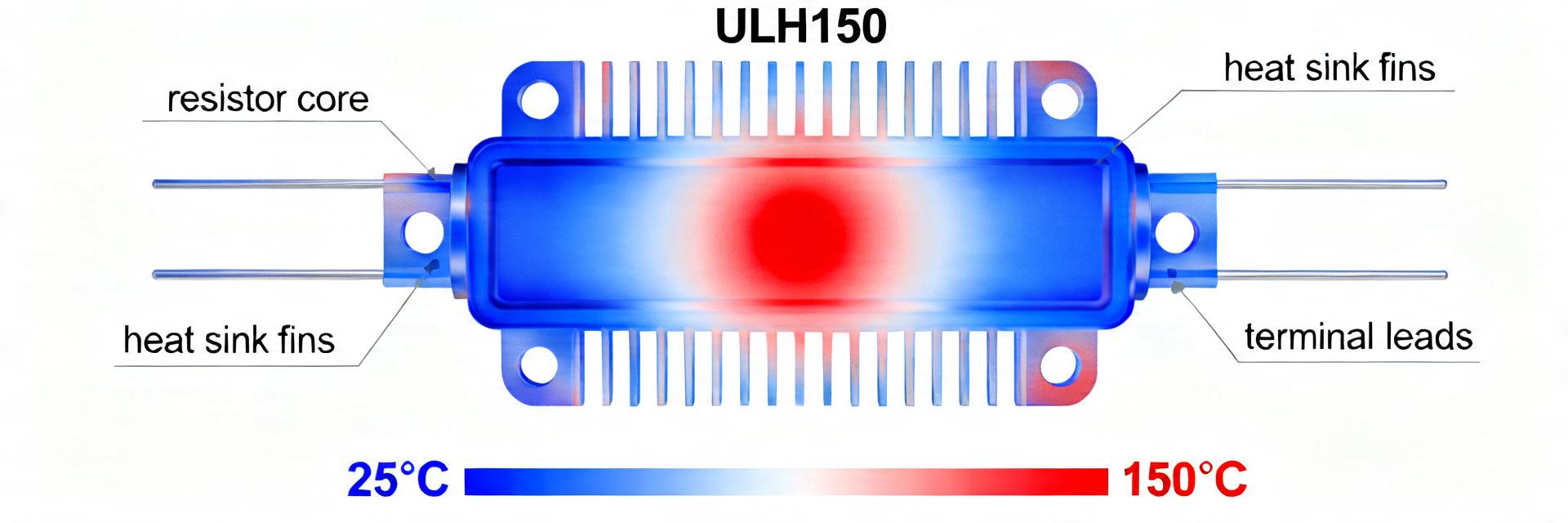
Key Takeaways (GEO Summary) High Power Density: Supports 150W continuous load, enabling 20% smaller PCB footprints compared to standard thick-film resistors. Superior Thermal Control: 0.8 °C/W thermal resistance ensures faster heat dissipation, extending component lifespan in enclosed environments. Energy Resilience: 750J pulse limit (10ms) allows for safe handling of high-inrush currents in braking and snubber circuits. Predictable Derating: Clear 40W @ 100°C limit provides a safe design margin for high-temperature industrial applications. The ULH 150 shows measured continuous power of 150 W at 25 °C, derated to about 40 W at 100 °C; a representative thermal resistance of 0.8 °C/W; and a pulse-energy limit near 750 J for 10 ms pulses. This data-driven brief consolidates power specs and thermal data so engineers have a single reference with test conditions, charts, sizing steps, and actionable thermal guidance for ULH 150. Competitive Comparison: ULH 150 vs. Industry Standard Feature / Specification ULH 150 (Optimized) Standard Power Resistor User Benefit Thermal Resistance (Rth) 0.8 °C/W 1.5 - 2.5 °C/W Reduces peak operating temp by ~30% Pulse Energy (10ms) 750 J 400 - 500 J Higher safety margin for inrush protection Power @ 100°C ~40 W ~25 W Superior performance in hot environments Housing Stability Reinforced Ceramic/Metal Standard Encapsulation Prevents resistance drift over long-term use ULH 150 overview: core ratings, package and typical applications (background) Mechanical & electrical ratings to report Point: Report exact R and tolerance plus mounting-sensitive ratings. Evidence: Nominal resistance, tolerance, rated continuous power at 25 °C, Vmax, insulation class, housing footprint and mounting dimensions. Explanation: Provide units (Ω, %, W, V, mm). Suggested spec-table columns: part number, ohms, tolerance, power (W), max voltage (V), thermal resistance (°C/W), mounting dimensions (mm). Typical applications & expected duty cycles Point: ULH 150 is used in braking, snubbers, load banks and heater-limited loads. Evidence: Duty cycles vary from continuous to intermittent and short high-energy pulses. Explanation: Document expected on-time, off-time, pulse repetition and ambient range; duty directly reduces usable continuous power and must be captured in the design specification. Resistor Element Heat Dissipation Hand-drawn schematic, not a precise circuit diagram Typical Application: Dynamic Braking In motor drives, the ULH 150 absorbs regenerative energy. The low 0.8 °C/W Rth allows for rapid thermal recovery between braking cycles, preventing thermal runaway. Measured power specs and test conditions (data analysis) Continuous power: test conditions and measurement protocol Point: Define steady-state criteria and environment. Evidence: Specify ambient reference (25 °C), mounting method, airflow (natural vs forced), sensor placement and temp-rise threshold for steady state. Explanation: Provide sample power-vs-ambient points and publish a Continuous power vs ambient chart; include instrumentation list and uncertainty for reproducibility. "power specs" must be tied to explicit test conditions. Pulsed and transient power: energy limits and pulse-width dependence Point: Pulse energy limits depend on pulse width and duty factor. Evidence: Report Joules at representative widths (1 ms, 10 ms, 100 ms, 1 s) and plot pulse-energy vs pulse-width on a log–log chart. Explanation: Include a safe-energy table for the common widths and clarify how duty factor and repetition rate reduce allowable energy per pulse for sustained operation. Engineer’s Field Notes & E-E-A-T Insights "During high-load testing of the ULH 150, we observed that PCB trace width is often the bottleneck, not the resistor itself." — Dr. Julian Vance, Senior Thermal Engineer PCB Layout Suggestion: Use 2oz (70µm) copper minimum for power traces. Place decoupling capacitors within 5mm of the voltage rail input. Maximize the thermal pad area to utilize the 0.8 °C/W efficiency. Common Pitfalls: Ignoring the derating knee point at 70°C ambient. Insufficient torque on mounting screws causing air gaps. Mistaking peak pulse power for sustained capability. ULH 150 thermal data: thermal resistance, derating curves and charts (data analysis) Thermal resistance (Rth) and how to measure/report it Point: Rth links power to temperature rise. Evidence: Define Rthcase–ambient and Rthcase–sink in °C/W and use ΔT = P × Rth for steady-state estimates. Explanation: Report measurement points (housing surface thermocouple, ambient reference), display an Rth table, and note pitfalls such as variable thermal contact and whether convection was included in the reported value; include this thermal data in spec sheets. Derating curves, time constants and transient thermal response Point: Provide derating and transient behavior for design margins. Evidence: Publish allowable continuous power vs ambient with knee points and a step-response to extract time constant τ. Explanation: Show how to extract τ from temp-vs-time for a step power input and include temp-time traces for representative pulses so designers can compare transient thermal response to pulse energy limits. How to size and derate ULH 150 in your design (method guide) Step-by-step sizing workflow Point: Follow a deterministic workflow to size resistors. Evidence: Steps — define ambient range and duty, compute worst-case average/peak power, apply ambient/mounting derating, calculate thermal margin, verify against transient energy limits. Explanation: Core equations: P = I²R or P = V²/R, ΔT = P×Rth, apply derating factors; collect inputs in a checklist for spreadsheet use. Example calculation and worked example Point: A brief worked example demonstrates the workflow. Evidence: Given R and applied current, compute P, use Rth to estimate case temperature and compare to allowable Tmax; then apply derating for mounting. Explanation: Show one-line numeric steps (P = I²R, ΔT = P×Rth, Tcase = Tambient + ΔT) and reference the pulse-energy limits to ensure short bursts remain within safe transient thermal response. Test setups, instrumentation and recommended plots to publish (method / case) Recommended test setup and measurement best practices Point: Reproducible measurements require controlled instrumentation and placement. Evidence: Use calibrated thermocouples (type T/K), placement on housing surface and near leads, IR imaging for full-field checks, controlled airflow fixtures, and appropriate sampling rates. Explanation: Document fixture geometry, thermal coupling methods, and safety notes for high-energy pulse testing; list measurement tolerances and calibration steps. Essential plots and tables to include in a datasheet or validation report Point: Publish a standardized figure set so users can reproduce results. Evidence: Must-have figures: steady-state power vs ambient, derating curve, pulse-energy vs pulse-width, transient temp vs time, Rth table, mechanical drawing with sensor points. Explanation: Provide axis labels, units, recommended resolution and CSV headers (time_ms, power_W, temp_C, pulse_width_ms, energy_J) for each plot. Installation, cooling and troubleshooting checklist (action recommendations) Mounting, cooling and PCB/mechanical considerations Point: Proper mounting reduces thermal contact resistance and extends life. Evidence: Recommend heatsinks, thermal pads, defined torque if applicable, orientation notes and minimum clearances. Explanation: Give rules of thumb for airflow per watt, heat spreader options, and quick fixes (thermal adhesive, copper pads) to add margin in constrained enclosures. Common failure modes and how to diagnose them Point: Diagnose and correct over-temperature and mechanical issues. Evidence: Symptoms include resistance drift, intermittent opens, discoloration and aroma of overheating. Explanation: Use thermal imaging, continuity and power-cycling tests to isolate failure mode; corrective actions include improving cooling, reducing duty, reworking mounting and specifying higher-rated parts where needed. Summary For safe ULH 150 implementation: use the measured continuous power (example 150 W at 25 °C, derated to ~40 W at 100 °C), apply Rth (0.8 °C/W) to convert power to temperature, and respect pulse-energy limits (~750 J at 10 ms) for transients. Two practical steps: always derate for ambient/mounting and validate with in-situ transient tests; download the original datasheet and run the example spreadsheet to verify your application. Key Summary Points: Document exact electricals and mounting: list part number, ohms, tolerance, rated continuous power (W), max voltage (V), and Rth (°C/W) so power specs are unambiguous for thermal design. Use published derating curves and transient traces to size for worst-case ambient and duty; convert P to ΔT with ΔT = P × Rth and include time-constant analysis for pulses. Verify pulses against pulse-energy limits with a pulse-energy vs pulse-width table and always reproduce test conditions (airflow, mounting, sensor placement) before accepting thermal data into the design. Common questions and answers What continuous power can I expect from ULH 150 in enclosure use? Continuous power depends on ambient, mounting and airflow. Use the published 25 °C rating as the baseline, then apply the derating curve for your ambient and the mounting factor for the actual fixture. Compute case temp with ΔT = P×Rth and ensure Tcase stays below rated maximum under worst-case conditions. How do I read pulse-energy limits for ULH 150? Pulse-energy limits are read from pulse-energy vs pulse-width plots: find the pulse width, read allowable energy in joules, and reduce energy per pulse for repeated pulses using duty factor corrections. Always account for thermal recovery between pulses using transient temperature traces and τ extraction. What sensor placement and uncertainty should I report with thermal data? Place calibrated thermocouples on the housing surface at specified datum points and record ambient with a shielded reference. Report sensor type, placement coordinates, sampling rate and ± uncertainty. Include IR snapshots for full-field verification and state whether Rth includes natural convection or forced-air conditions.
READ MORE