ULV Resistor Thermal Report: Datasheet Deep Dive Quick Guide
Point: Recent product surveys show a clear migration toward higher power density and compact packages in braking and load-bank designs, increasing thermal risk for compact components.
Evidence: Industry sampling indicates a double-digit rise in designs using compact ULV form-factors.
Explanation: This guide helps engineers read a ULV resistor datasheet, extract critical thermal specs, and convert those values into reliable design decisions.
Scope: Practical interpretation of datasheet entries, defining repeatable test protocols for prototype sign-off.
ULV Resistor at a Glance: Design, Use Cases, and Why Thermal Matters
What makes ULV resistors distinct
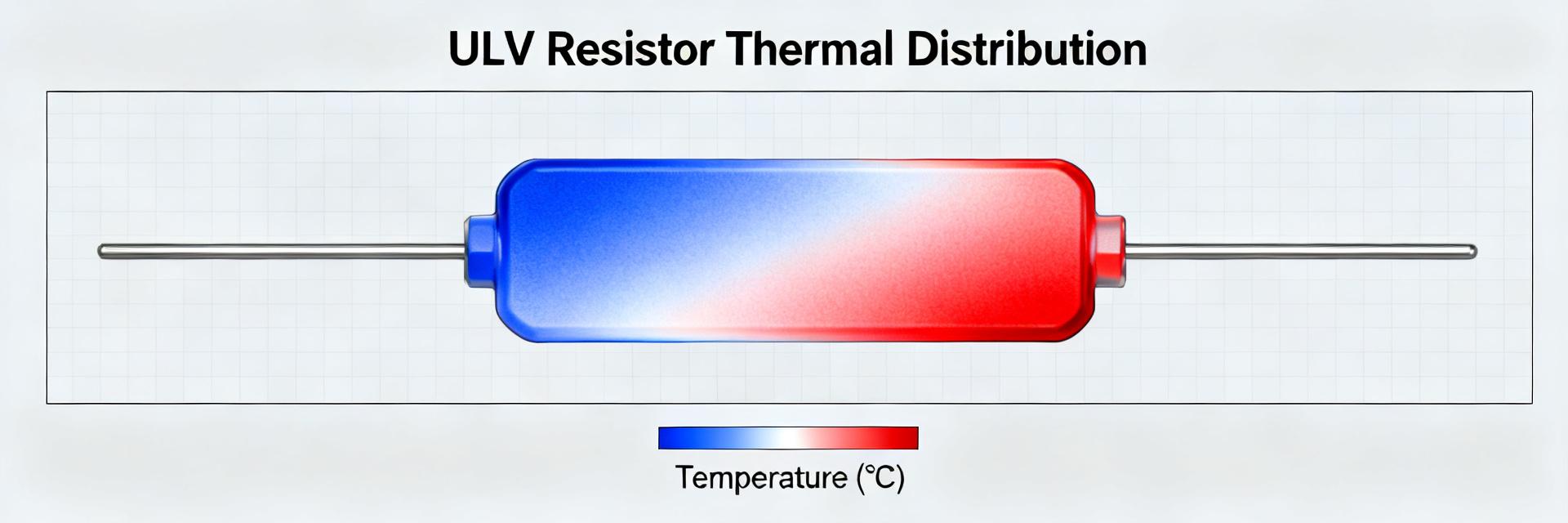
Point: ULV resistors combine compact envelopes with relatively high dissipation per unit volume.
Evidence: Typical construction uses a metal-clad housing and chassis-mount flange establishing the primary heat path.
Explanation: Chassis conduction is the dominant cooling route; designers must prioritize mounting behavior.
Key thermal failure modes
Point: Several measurable failure modes recur in field returns.
Evidence: Hotspots, exceeded insulation class, and terminal derating are common root causes.
Explanation: Exceeding 120–150°C case limits or solder ratings shortens life and raises safety risk.
How Thermal Specs Appear on a ULV Resistor Datasheet
Typical thermal spec items and what they mean
Point: Datasheets list rated power (on-chassis vs free air), thermal resistance (°C/W), and pulse energy specs.
Evidence: Each entry carries reference conditions—mounting area or air movement.
Explanation: Confirm units; listed thermal resistance usually maps case-to-ambient or case-to-chassis.
Red flags and ambiguous entries
Point: Ambiguity undermines safe design.
Evidence: Vague “operating temperature range” without test conditions is a red flag.
Explanation: Always ask: was power measured on a defined heat-sink? If airspeed is missing, lab characterization is mandatory.
Repeatable Thermal Test Methods
Interpreting Steady-State vs Pulsed Charts
Worked Example: Power vs. Temperature Rise
Example: 140 W On-Chassis (Rth 0.5°C/W) vs 100 W Free-Air (Rth 0.9°C/W).
Explanation: At 40°C ambient, On-Chassis case ≈ 110°C; Free-Air case ≈ 130°C. This helps check insulation class limits.
Pulse Energy (E = C·ΔT): Short pulses (t
Practical Examples & Common Pitfalls
Example A: Continuous Braking
120 W with 0.6°C/W = 72°C rise. At 35°C ambient, case ≈107°C. Acceptable if insulation class ≥130°C.
Common Pitfall
Designers often use free-air ratings for chassis-mounted parts or confuse pulse vs steady ratings. Validate with lab tests.
Engineer’s Quick Selection & Verification Checklist
Pre-selection Checklist
- ✅ Confirm rated power (Chassis vs Free Air)
- ✅ Check Thermal Resistance (°C/W)
- ✅ Max Case/Terminal temperatures
- ✅ Verify Pulse Specs vs Energy (J)
Field Verification Plan
- 📋 Instrumentation: K-type TCs & Calibrated IR
- 📋 Pass/Fail: Case temp
- 📋 Archive TC locations and timestamps
Summary
Point: Align datasheet thermal specs to real mounting and duty conditions.
Evidence: Matching °C/W, derating curves, and time-constant behavior prevents surprises.
Call to Action: Use the checklist and test plan to reduce thermal risk before prototype sign-off; validate ambiguous entries experimentally.
- Extract and confirm thermal specs—rated power reference and thermal resistance.
- Use steady-state and pulse test protocols with calibrated TCs.
- Compute pulse allowance from time-constant or E = C·ΔT formula.
Frequently Asked Questions
How should an engineer interpret ULV resistor pulse ratings?
Answer: Convert pulse specs to a common energy metric (Joules). If durations or voltage/current are specified, perform a fixed-energy pulse test to confirm temperature rise if conditions differ from the datasheet.
What is the best way to convert thermal resistance into case temperature?
Answer: Use ΔT = P × Rth. Multiply power by thermal resistance to get the temperature rise, then add your ambient temperature to find the final case temperature.
When is laboratory verification mandatory?
Answer: Mandatory whenever datasheet conditions (mounting area, airspeed) differ from your real profile. Run tests replicating real use to establish pass/fail criteria before production sign-off.