SOMC160110K0GRZ399 datasheet: Full electrical report
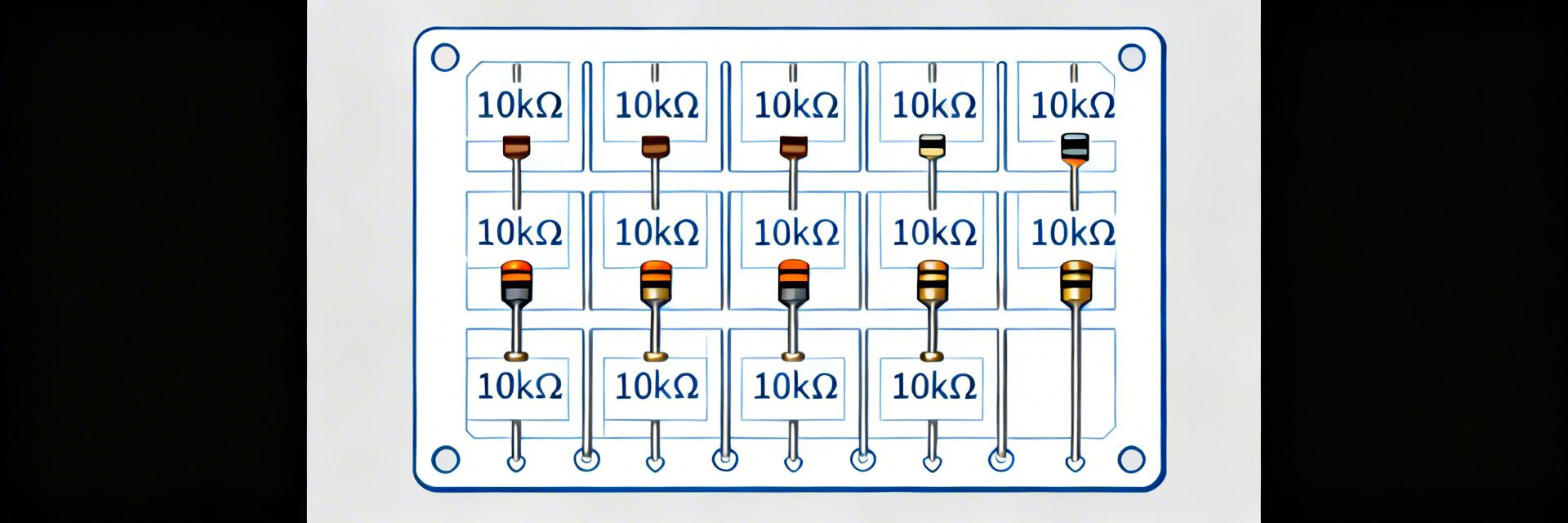
The SOMC160110K0GRZ399 is a 15-element resistor network engineered for precision divider and bussed applications. This comprehensive report details electrical specifications, thermal constraints, and validation procedures essential for high-reliability circuit design.
Product Overview & Key Specifications
Part-Number Meaning & Circuit Options
Point: The part code encodes element count, resistance value, tolerance, and internal topology (bussed vs. isolated).
Evidence: Typical arrays offer a bussed common plus isolated elements in a single package.
Explanation: Simplified pull-ups and common references for system design; isolated elements support independent divider channels. Always verify topology on the datasheet schematic before net assignment.
Detailed Electrical Specifications & Limits
Resistive Performance: Tolerance, TCR & Stability
The ±2% tolerance and 100 ppm/°C TCR determine worst-case behavior. For precise calculations, use the formula:
R_at_T = R_nominal × [1 + (TCR × ΔT)].
• R_drift = 10,000 × [1 + (100e−6 × 60)] = 10,060 Ω
• Worst-case High (+2%): 10,261 Ω
• Worst-case Low (-2%): 9,859 Ω
Power, Voltage and Current Limits
Note: Adjacent element heating reduces effective dissipation. Refer to the derating curve for temperatures above 70°C.
Package, Pinout & Mechanical Data
PCB Footprint Recommendations
- Provide 0.5–1 mm solder fillet clearance.
- Maintain copper pour with thermal relief for dissipation.
- Use thermal vias under the package for improved heat spreading.
Soldering & Reflow
- Lead-free reflow peak: ~245°C.
- Minimize loop area in routing for precision networks.
- Avoid excessive mechanical shear during assembly.
Performance Testing & Validation
Bench Test Procedures: Use a 4-wire resistance measurement for absolute accuracy. Perform a stepped-load power test while monitoring temperature rise via thermocouple to verify thermal stability.
Reliability Data: Load-life stability is the critical metric. If measured drift exceeds ppm specifications, investigate soldering thermal history, PCB mechanical stress, or chemical contamination.
Application Selection Checklist
Key Summary
- • 10 kΩ ±2% Precision: TCR of 100 ppm/°C requires careful accuracy budgeting for high-temp environments.
- • Electrical Limits: I_max ≈ 2.83 mA and V_max ≈ 28.3 V per element; apply linear derating above 70°C.
- • Thermal Design: Use copper pours and thermal vias to ensure long-term reliability and load-life stability.
Frequently Asked Questions
What test steps verify SOMC160110K0GRZ399 resistance and matching? +
How do I compute safe voltage and current limits? +
What if measured drift exceeds the datasheet load-life stability? +
Ready for Implementation?
Retrieve the official SOMC160110K0GRZ399 datasheet PDF and verify your PCB footprint before production.